

As businesses evolve and grow, it is important that processes and the technology that underpins them keeps pace. HydroChem embarked on a major project a couple of years ago to backfill what they saw as a barrier to improving their Victorian laboratory’s efficiency and responsiveness. The fruits of their labour are now driving the kind of tangible efficiencies that saw adoption of the project in the first place.
The project is a close collaboration between the HydroChem laboratory and IT departments. The laboratory team has historically run a relatively common, open-source software solution referred to as a Laboratory Information Management System (LIMS). Open-source software is software with source code that anyone can inspect and modify or enhance to suit their unique requirements.
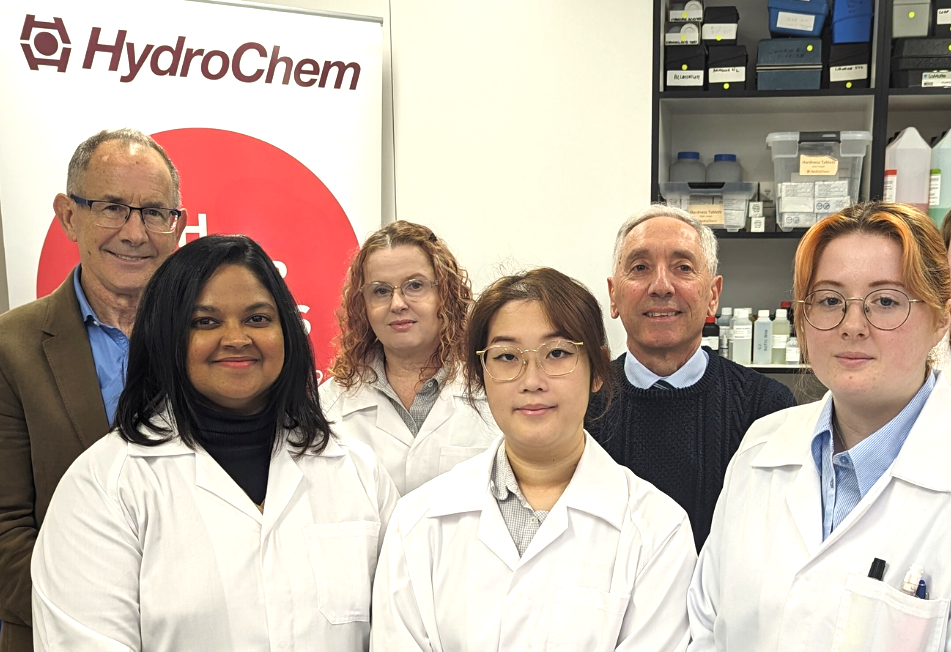
HydroChem laboratory team led by Director of Strategy & Technology, Mark Preston (L)
A large part of the day-to-day work in the HydroChem laboratory relates to efficiently tracking, labelling and storing samples, as well as recording test results and producing professional reports for both internal and external customers. A LIMS provides the structure needed to handle high volumes of data, simultaneously improving accuracy, workflow visibility, and reporting speeds.
The challenge for HydroChem has been the customisation of their LIMS software to meet their unique set of needs, including building algorithms to enable the company to identify the ideal operating conditions for different waters around Australia. Once the requisite software changes were known, an experienced LIMS developer was needed to make the series of adjustments required.
South African LIMS solution provider, Bika Labs, are Cape Town based but run a global customisation business. Bika has a track record for successful customisations going back 25 years.
The level of customisation needed would have been difficult to achieve with a closed-source, proprietary LIMS. Working on an open-source platform, HydroChem was able to identify the required enhancements and collaborate directly with Bika Labs who in turn developed a solution designed to integrate with the unique workflows of our industry.
One of the key developments borne out of this collaboration and sponsored by HydroChem, is the Sample Point Location feature. This functionality was created to suit the HydroChem operating model where sample points are grouped according to client locations. Bika Labs expanded the system to include a two-tier structure, locations and their associated sample points. This necessitated the creation of a new suite of Certificates of Analysis (COAs) to align with the new reporting format. To ensure seamless operation, HydroChem’s customer database syncs daily with the LIMS location database maintained by Bika Labs.
An optimised LIMS has improved the handling of data in the HydroChem laboratory in several ways including:
- Enhanced traceability
- Full tracking of samples and results – past and present – supported by barcode-based identification.
- Greater efficiency
- Reduced double handling of data leading to faster searches, and quicker report generation.
- Improved workflow management
- Ability to create unique worksheets for technicians and workstations, which delivers optimal instrument utilisation.
- Robust data management
- Secure storage and handling of the large datasets generated during testing.
- Data integrity
- Maintains audit trails and version control to ensure accuracy and compliance.
- Better quality control
- Tracks instrument calibration schedules and quality requirements.
- Instant reporting
- Automated generation of reports from verified results with easily assigned specifications.
The HydroChem and Bika Labs LIMS collaboration has enhanced laboratory efficiency by automating manual processes, drastically reduced paperwork, minimised errors, and supports consistent, high calibre reporting.
Bika Labs continues to provide technical support.